Stop Claiming You Have Great Customer Service. Nobody’s Listening.
The one thing B2B professionals keep saying that tanks their credibility before they leave the room

Every week, in networking rooms and virtual coffees across the country, the same script plays out.
“We really pride ourselves on customer service.”
“We go above and beyond for our clients.”
“We’re just not like the other guys.”
And every week, the person on the other side nods, files it away as noise, and forgets it before they get to their car.
That’s not a guess. After talking with thousands of B2B professionals about what actually builds trust and drives referrals, the pattern is impossible to ignore. Nobody can recall what the last person said about their customer service. But they remember exactly how that person made them feel.
Why “We Go Above and Beyond” Is the Worst Thing You Can Say
Think about what you’re actually doing when you lead with service claims.
You’re not differentiating yourself. You’re blending in. Every competitor in your market says some version of the same thing. “World-class service.” “Client-first mentality.” “We treat you like family.” The words exist in every sales conversation, every LinkedIn profile, every pitch deck. They’ve lost all meaning.
But the bigger problem is what those words signal without you realizing it.
When you fill space with claims about how great you are, the person across from you registers something they can’t quite name: this person doesn’t know what to say. Leading with credentials before context reads as insecurity. It tells people you’re more focused on impressing them than understanding them.
The filter goes up. And once that filter goes up, nothing you say is getting through.
What People Actually Remember From a Conversation
Ask yourself who you actually trust in your professional network. Not who you vaguely like. Who you actually refer business to without thinking twice.
Chances are, it’s not the person with the tightest elevator pitch. It’s the person who remembered something specific about you. Who sent a follow-up that proved they were paying attention. Who did the thing they said they’d do, even when it was small, even when nobody would have known if they hadn’t.
That’s the résumé that builds a referral business.
Not the claim. The proof.
And proof doesn’t require a speech. It requires five minutes of showing up the right way while someone is watching.
The Five-Minute Window That Defines Your Reputation

In any networking interaction, there’s a short window where the other person is forming an opinion they’ll carry indefinitely. Most people spend that window talking about themselves.
The people who build the strongest networks spend it differently.
They ask about the other person’s business before mentioning their own. They remember details from prior conversations and bring them back up. They listen long enough to ask the one follow-up question that shows they actually heard what was said.
None of that requires a marketing budget. It requires attention.
And here’s the thing about attention: it’s rare enough that people notice it immediately. It gets through every filter. It sticks.
How the C3 Model Changes the Way You Think About Reputation
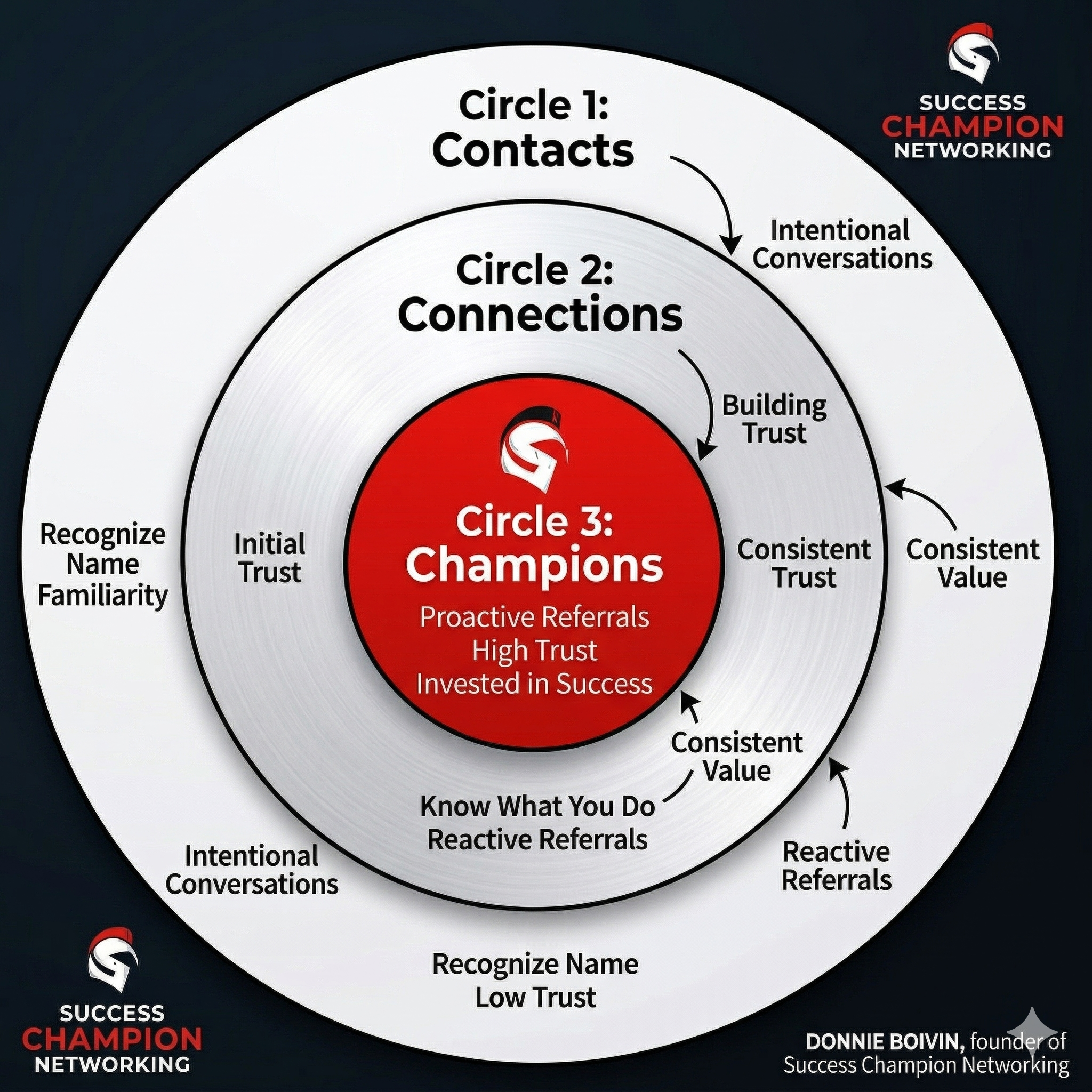
There are three types of people in your network: Contacts, Connections, and Champions.
Contacts know your name. Connections trust you. Champions bring your name up in rooms you’re not in.
The jump from Contact to Champion doesn’t happen because of how well you described your services. It happens because of accumulated proof. Every interaction where you showed up with attention, followed through, and made someone feel seen. That’s what moves people through the circles.
Champions don’t repeat your elevator pitch. They share what they’ve experienced. So if what they’ve experienced is a version of “we go above and beyond,” you’ve given them nothing worth repeating.
Give them a story instead. Give them evidence. Give them the moment where you proved it.
What to Do Instead of Talking About How Good You Are
Stop spending energy on how you describe your value. Put that energy into how you deliver it in real time.
Ask one question per conversation that you actually want to know the answer to. Send the follow-up that proves you were listening. Remember the thing they mentioned in passing and bring it up next time.
That’s the work. It’s not glamorous, but it compounds.
The people who don’t have to sell themselves anymore, who get referrals without chasing, who get introduced in rooms they haven’t walked into yet, they got there because their behavior built the story their network now tells for them.
Your reputation is not what you claim in a conversation. It’s what people say when you’re not in the room.
Build that instead.
Watch the Youtube Live Video Here
Frequently Asked Questions
Why don’t customer service claims work in networking? Because everyone makes them. When every competitor says the same thing, the claim carries no weight. It doesn’t differentiate you, and trust doesn’t come from self-reported quality. It comes from demonstrated behavior.
What actually builds a strong professional reputation? Consistent, small behaviors that prove you were paying attention. The follow-up message. The detail you remembered. The thing you said you’d do that you actually did. These are what the people who refer you most readily will actually talk about.
How do I get more referrals without asking for them? Give people something worth talking about. Show up to every interaction focused on them first. Make it easy for someone to tell a story about you, because you’ve given them one worth telling.
What is silent reputation in business networking? Silent reputation is what people know about you from experience, not from what you’ve told them. It’s the judgment your network carries about your reliability, your attention, and your follow-through. It gets built whether you’re intentional about it or not.