Most people don’t have a network. They have a list. Here’s what that actually costs.
He had over 30,000 connections on LinkedIn.
He was broke.
Not struggling. Not having a slow quarter. Broke. No referrals coming in. No introductions being made. Nobody picking up the phone to say hey I know someone you need to meet.
Thirty thousand people who knew his name and not one of them was helping him build his business.
He thought that number made him somebody. He had spent years building a following and somewhere along the way convinced himself that visibility was the same as value.
It wasn’t.
He eventually had to go get a job. Thirty thousand people who knew his name and not one of them could save his business.
When he came to Success Champion Networking and told me this I wasn’t surprised. I had seen it a hundred times before. Big numbers. Empty pipeline. A network that looked impressive and produced nothing.
The problem wasn’t him. The problem was he had spent years building a list and calling it a network.
Those are not the same thing.
The difference between a list and a network
You don’t have a network. You have a list. And those are not the same thing.
A list is a collection of people who know your name.
A network is a collection of people who would risk their reputation to say it.
Most people have a list. They’ve been told their whole career to collect contacts, grow their following, expand their reach. So they do. They connect with everyone on LinkedIn. They hand out business cards at every event. They follow up with a generic message and call it relationship building.
Then they wonder why none of it produces anything.
Nobody in the networking world wants to say it out loud. Size means nothing. Reach means nothing. The number next to your name on LinkedIn means nothing if nobody in that list is out there opening doors for you.
The only number that matters is how many people would bring your name up in a room you’re not in.
For most people that number is terrifyingly small.
The C3 Model — three levels every relationship lives at
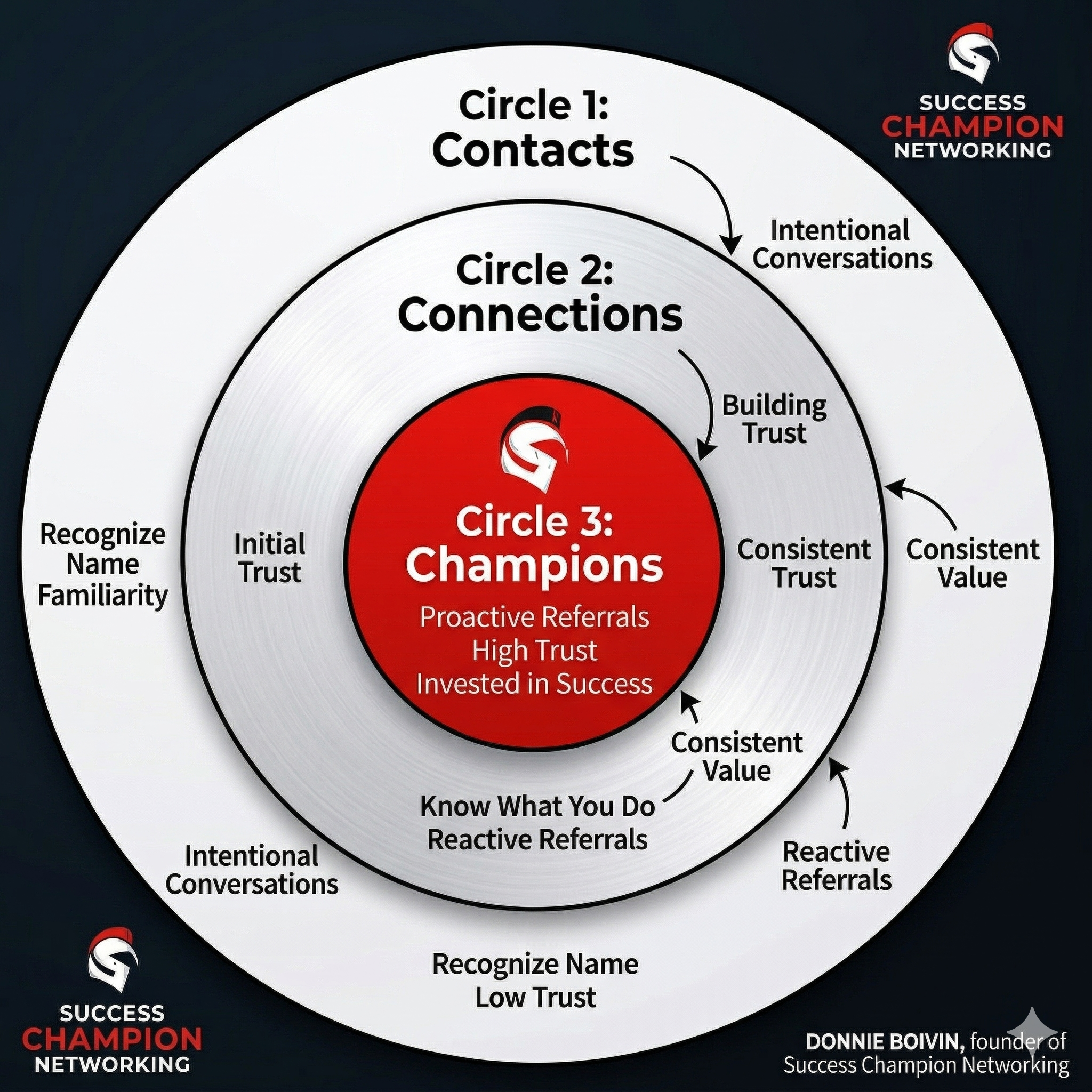
I built the C3 Model because I needed a way to show people exactly where their relationships actually stand versus where they think they stand.
It’s three concentric circles. Every person in your network lives in one of them at any given time. And most people have thousands in the outer ring and almost nobody in the middle.
Here’s what each one means.
Circle 1: Contacts
Contacts are people who recognize your name.
That’s it. They’ve seen your content, met you at an event, connected on LinkedIn, maybe exchanged a few messages. If you walked up to them at a conference they’d know your face. If someone mentioned your name they’d say oh yeah I know him.
But they couldn’t tell you specifically what you do. They couldn’t explain who your ideal client is. They definitely aren’t thinking about you when they’re in a conversation with someone who needs exactly what you offer.
Recognition is not relationship. Recognition is just familiarity.
The man with 30,000 LinkedIn connections had 30,000 Contacts. He had spent years being recognized and zero time being known.
Most people live here. Most people stay here. And most people can’t figure out why their network isn’t working because they’ve confused being known of with being known.
Circle 2: Connections
Connections are people who trust you.
Not just like you. Trust you. There’s a difference. You can like someone you met twice. Trust is built through time, through repeated interaction, through watching someone do what they said they were going to do over and over again.
Research on relationships shows it takes somewhere between 50 and 200 hours of interaction to move someone from acquaintance to genuine friend. That number shocks people because they think a great first conversation counts for more than it does.
It doesn’t. Trust is built in accumulated hours, not single moments.
Connections are the people you’ve put the time in with. They know what you do. They believe in how you do it. They’re in your corner. But they’re not quite there yet — they haven’t crossed the line into actively championing you without being asked.
This is where growth actually lives. The move from Contact to Connection is where most people get stuck because it requires investment — real time, real conversations, real follow-through — and most people aren’t willing to make that investment without a guaranteed return.
The guaranteed return doesn’t come until the next circle. Which is exactly why most people never get there.
Circle 3: Champions
Champions are people who say your name when you’re not in the room.
Not when you ask them to. Not when you remind them. They do it automatically because they believe in you so completely that connecting you with the right person feels like something they get to do, not something they’re obligated to do.
A Champion doesn’t wait for the perfect moment to refer you. They create the moment. They’re in a conversation and someone mentions a problem and your name comes out of their mouth before they’ve even consciously thought about it.
One Champion is worth a thousand Contacts.
I mean that literally. One person who proactively brings your name up in the right rooms will generate more business for you than thirty thousand people who recognize your face on LinkedIn and scroll past your posts.
The woman with 30,000 connections didn’t have a single Champion. Not one person in her entire network who was out there actively working on her behalf. And until he understood that distinction he had no idea what to fix.
You cannot skip circles
This is the part people don’t want to hear.
You cannot manufacture a Champion. You cannot shortcut your way from Contact to Champion with a great pitch or a clever follow-up sequence or a really good cup of coffee. The circles have to be earned in order.
Contact first. Connection next. Champion last.
The timeline is not fast. Building a genuine Champion relationship takes months of consistent investment. Multiple conversations. Delivered value. Demonstrated integrity. The accumulation of small moments that add up to someone thinking I would stake my reputation on this person.
But the people who play the long game on relationships end up with something nobody can copy. Not your offer. Not your pricing. Not your marketing. Your Champions are yours. They chose you because of who you are and how you showed up over time and no competitor can replicate that.

Where to start this week
Look at your network right now. Not all of it. Just the last twenty people you connected with or talked to.
Ask yourself honestly where each one lives. Are they a Contact — they know your name but not much else. Are they a Connection — they trust you and you’ve put real time in. Or are they a Champion — they’re out there right now, without being asked, opening doors for you.
Most people find they have a lot of Contacts, a handful of Connections, and almost no Champions.
That’s not a failure. That’s just data. Now you know what to work on.
Stop adding to the list. Start deepening the relationships already on it. Pick five people you’re going to move from Contact to Connection in the next 90 days and invest in those five like your business depends on it.
Because it does.
Frequently Asked Questions
How many Champions do I actually need? More than you think and fewer than you have Contacts. Five genuine Champions who are actively working on your behalf will outperform five hundred passive connections every single time. Quality is the entire game.
How do I know when someone has moved from Connection to Champion? You’ll know because you won’t have to ask. Champions refer you without prompting, introduce you without being nudged, and talk about you in rooms you don’t even know about. If you’re still reminding people to refer you, they’re a Connection at best.
Can someone move backward in the circles? Yes. Trust is hard to build and easy to lose. Someone who was a Champion can drop back to Connection or even Contact if you stop investing in the relationship or if you damage the trust. The circles are not permanent. They require maintenance.
What’s the fastest way to move someone from Contact to Connection? Consistent, purposeful one-on-one conversation over time. Not a great single coffee. Not a clever LinkedIn message. Repeated interaction where you show up, deliver value, follow through on what you said you’d do, and make the other person feel genuinely known. There is no shortcut.
What does this have to do with SCN? Everything. Success Champion Networking is built entirely around the C3 Model. Every chapter, every meeting, every framework inside SCN exists to move people from Contacts to Connections to Champions inside a structured community that makes the process repeatable. It’s not networking. It’s relationship architecture.
If you know someone who’s grinding away at a big network that isn’t producing anything, send this to them. It might change how they see every relationship they have.